Dedicated Server vs. Bare Metal Server: Key Differences
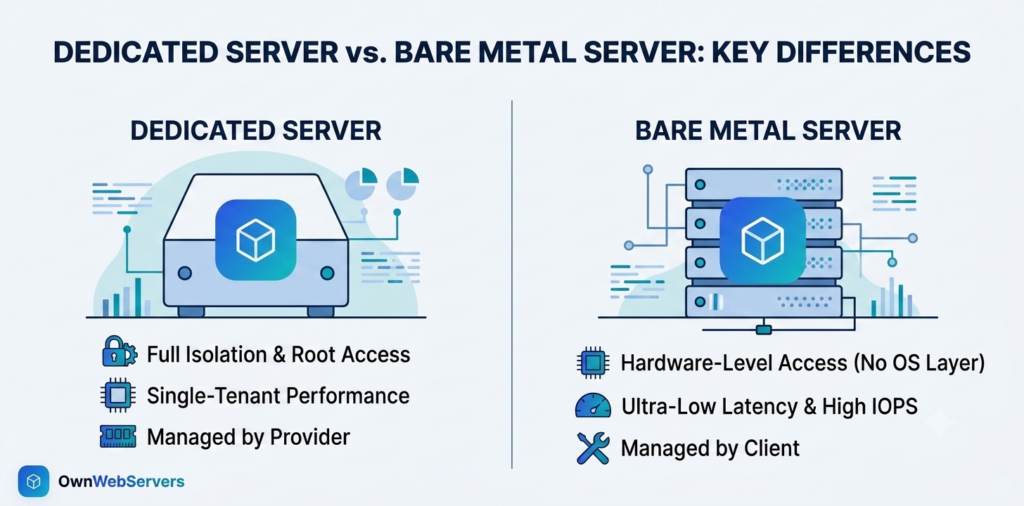
As a business owner, selecting the right server infrastructure is a crucial decision for your online presence. At OwnWebServers, we often see customers torn between two popular options: dedicated servers and bare metal servers. Both offer exclusive use of resources, but they cater to different needs and use cases. In this article, we’ll delve into the characteristics of each, their use cases, and the key differences between dedicated servers and bare metal servers.
What is a Dedicated Server
A dedicated server is a physical server that is exclusively allocated to a single user or organization. It’s typically provisioned on existing hardware, and the user has full control over the server’s resources, including CPU, memory, and storage. As a managed hosting provider, we handle maintenance, security, and technical support for our dedicated servers.
Key Features of Dedicated Servers
- Exclusive use of resources
- Full control over server configuration
- Managed by the hosting provider
- High security and reliability
Use Cases for Dedicated Servers
Dedicated servers are ideal for high-traffic websites, resource-intensive applications, and businesses that require high security and reliability. They’re also suitable for organizations that need to comply with specific regulatory requirements, such as HIPAA or PCI-DSS. If you’re looking for a hassle-free experience and don’t want to worry about server management, Intel Dedicated Servers are an excellent choice.
What is a Bare Metal Server
A bare metal server is a physical server that is provisioned without any virtualization layer. It provides direct access to the hardware, allowing for custom configurations and low-level system customization. Bare metal servers are often preferred by users who require specific hardware configurations or need to optimize their server performance. With our bare metal servers, you can choose from a range of hardware configurations, including NVMe storage and GPU acceleration.
Key Features of Bare Metal Servers
- Direct access to hardware
- Custom hardware configurations
- No virtualization overhead
- High performance and flexibility
Use Cases for Bare Metal Servers
Bare metal servers are ideal for applications that require high performance, such as gaming, video streaming, and scientific simulations. They’re also suitable for businesses that need to optimize their server performance and have specific hardware requirements. If you’re looking for a server that can be tailored to your exact needs, bare metal is the way to go.
Dedicated Server vs Bare Metal Server: Key Differences
| Attribute | Dedicated Server | Bare Metal Server |
|---|---|---|
| Hardware Configuration | Existing hardware | Custom hardware configurations |
| Virtualization | May include virtualization layer | No virtualization layer |
| Performance | Good performance, but may be affected by virtualization overhead | High performance due to direct hardware access |
| Security | High security, but may share resources with other virtual machines | High security, with no shared resources |
| Scalability and Flexibility | Good scalability, but may be limited by existing hardware | High scalability and flexibility, with custom hardware upgrades |
| Management and Control | Managed by the hosting provider | Requires more administrative effort from the user |
| Cost and Resource Allocation | Typically more expensive than shared hosting, but less expensive than bare metal servers | Can be more expensive than dedicated servers, due to custom hardware configurations |
Based on the comparison above, dedicated servers are ideal for businesses that require high security, reliability, and managed hosting solutions. Bare metal servers, on the other hand, are suitable for applications that require high performance, custom hardware configurations, and low-level system customization.
Choosing Between Dedicated Server and Bare Metal Server
When choosing between a dedicated server and a bare metal server, consider the following factors:
- Performance requirements: If your application requires high performance, a bare metal server may be a better choice.
- Security requirements: If your business requires high security and reliability, a dedicated server may be a better choice.
- Custom hardware configurations: If you require specific hardware configurations, a bare metal server is a better choice.
- Management and control: If you prefer a managed hosting solution, a dedicated server is a better choice.
- Cost and resource allocation: If budget is a concern, a dedicated server may be a more affordable option.
Best Practices
When deploying a dedicated server or a bare metal server, follow these best practices:
- Monitor server performance and adjust configurations as needed.
- Implement robust security measures, such as firewalls and intrusion detection systems.
- Regularly update and patch server software to prevent vulnerabilities.
- Use high-quality hardware components to ensure reliability and performance.
- Consider using a managed hosting solution to reduce administrative effort.
Troubleshooting
Common issues with dedicated servers and bare metal servers include:
| Symptom | Cause | Fix |
|---|---|---|
| Server performance issues | Insufficient resources or poor configuration | Adjust server configuration or upgrade resources |
| Security breaches | Weak passwords or unpatched vulnerabilities | Implement robust security measures and regularly update software |
| Hardware failures | Low-quality hardware components or poor maintenance | Use high-quality hardware components and regularly perform maintenance tasks |
Conclusion
Dedicated servers and bare metal servers offer exclusive use of resources and high performance. However, they differ in their hardware configurations, virtualization, performance, security, scalability, and management. By understanding the key differences between these two options, you can make an informed decision that meets your business needs and ensures the success of your online presence.